
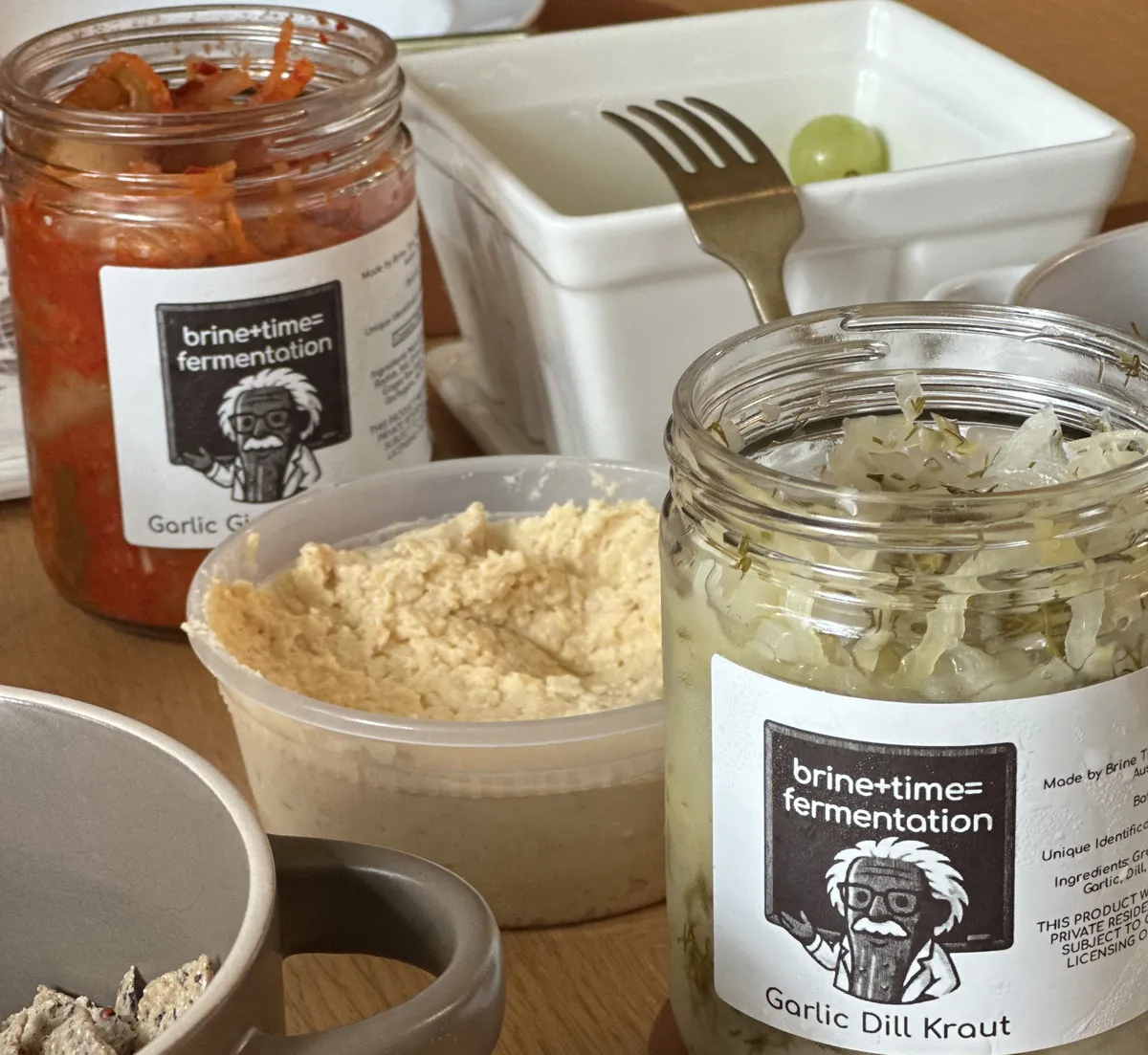
Lacto-fermentation is the oldest way people have kept vegetables from going bad. You take vegetables, salt, and water, put them in a jar, and give it time. Bacteria that already live on the vegetables, mostly the Lactobacillus family and their relatives, eat the natural sugars and turn them into lactic acid. That acid is what makes sauerkraut sour, kimchi tangy, and a real deli pickle taste like a pickle. It’s also what keeps the food safe.
That’s the short answer. Brine + time = fermentation. It’s simple science, really.
When people at the booth ask me what sauerkraut or kimchi is, here’s how I put it. It’s water, salt, a vegetable, and the bacteria that live on the skin of that vegetable. Give that bacteria the right ingredients and the right environment and it thrives, and it starts fermenting. Just like kids and people and everyone. If you give us the things we need and the right environment, we thrive too. This is the same thing taken down to a microscopic level, and it transforms our food.
The longer answer is how it works, how I do it, and why I built a whole business around a jar of salty cabbage.
Wait, is there milk in it?
No. I don’t usually call it lacto-fermentation. At the booth I just say fermentation. But if you’ve seen the word online, you might be wondering about the “lacto” part.
It comes from lactic acid, the stuff the bacteria make, and from Lactobacillus, the family of bacteria that makes it. Lactic acid got its name because it was first found in sour milk, back in the 1700s, and the name stuck to everything that makes it. My kraut and kimchi never go near dairy. It’s vegetables, salt, water, and the bacteria that were already living on the vegetables.
What’s actually happening in the jar
I’m not really making anything. I’m getting the right setup together, giving nature the right materials and the right environment, and then nature makes the food safer and makes it last longer. I just keep it on track.
Salt comes first. It pulls water out of the vegetables and holds back the microbes you don’t want while the good ones get going. Everything has to stay under the brine, because the lactic acid bacteria do fine without air and mold doesn’t.
Then the bacteria go to work. As they eat sugars they make lactic acid and carbon dioxide. The CO2 is the fun part. You can watch bubbles rise off the vegetables, up through the brine, and out the top.
The acid builds up and the pH drops. Once the jar is acidic enough, the stuff that could make you sick can’t grow. The acid is the safety system.
And the whole time, it keeps changing. Different bacteria take the lead at different points, and at each stage the flavor and the bacterial profile change. A day-three kimchi and a day-thirty kimchi are practically different foods.
Where it fits in the family of ferments
I’ve spent a lot of my life fermenting things. Beer, wine, cheese. I’ve grown mushrooms too, which isn’t fermentation, but it works a lot the same as far as how we humans nurture the process.
Almost all of those start the same way: you add a culture from somewhere else. Yogurt gets bacteria added to milk, and those bacteria make the acid that sets it. (Fun part: yogurt bacteria are lactic acid bacteria too, cousins of what’s in my kraut.) Cheese gets a culture. Beer and kombucha get an established culture added to a medium, and then you create the right set and setting for it. Sourdough is sneaky close to kraut, since a starter is wild yeast and lactic acid bacteria caught from the flour and the air. But once you’ve got a starter, you add it to dough like any other culture.
Lacto-fermentation doesn’t need any of that. The bacteria are already on the vegetables. You don’t need a kimchi starter. You don’t need a sauerkraut starter. We don’t add anything.
I can give it a head start, though. If I’m making batch 21, I can add a little of batch 20, and those established cultures kick the fermentation off faster. There’s a name for that: backslopping. Not the prettiest word in the fermentation glossary.
Lacto-fermented vs. vinegar pickled vs. canned
I grew up with all three.
We had what I called a farm when I was a kid. You know how you go back to your old elementary school and it looks miniature? That’s the farm. It was a pretty small patch of garden. But to me it was huge, and it was my happy place. I spent a lot of time out there with my dad, growing things, building things, basically being facilitators of nature so we could work with it to feed ourselves.
We always had more food than we could eat, so we preserved it. People have been figuring out ways to do that for thousands of years, and we did a few of them.
Canning cooks the vegetables in mason jars, pushes the air out, and seals a vacuum inside the jar. Pretty cool process, and very simple. But it’s cooked. Nothing in there is alive.
Vinegar pickling is what my dad did with a lot of our cucumbers. Here’s a fun detail most people don’t know: vinegar is a fermentation product too. Sugars get turned into alcohol, and then a different bacteria turns that alcohol into vinegar. So vinegar pickles are borrowing acid from a fermentation that already happened somewhere else. And vinegar pickles are amazing. I still use my dad’s old recipe, and I might sell them someday.
Lacto-fermentation is the oldest of the three. Salt, water, vegetables, time. The acid gets made right there in the jar by the bacteria living in it, and unless someone heats it afterward, those live cultures are still in there when you open it. A lot of what’s sold as “fermented” at the store has been pasteurized, which kills the cultures along with everything else.
You can taste the difference, too. Vinegar just kind of soaks in. Fermentation gives it this effervescence when you bite into it. It tingles and glows and floats around inside your mouth, and it changes the way it touches your teeth. It’s a much more developed experience.
Honestly, as a kid, I didn’t understand any of this. That came much later.
Sauerkraut vs. kimchi
Both are lacto-fermented. The difference is how they get there.
Sauerkraut is done in brine. The cabbage gets salted, it gives up its juice, and everything it releases stays in the jar with it.
Kimchi is different. I salt the cabbage first, which pulls a lot of the water out of it. That liquid is basically brine. Most of it gets discarded, but some of it goes into the paste. Then the paste, garlic and ginger and the rest, gets coated onto every surface of every piece of vegetable, and the whole thing gets packed tight into the jar. It’s less salt-and-water and more salt plus a layer of ingredients, and it’s a quick ferment. Once it’s in the jar, it gets going fast.
How I do it at Brine Time
Salt. I use about 2 to 3 percent salt by weight, water plus vegetables. So if everything in the jar weighs 100 ounces, that’s 2 to 3 ounces of salt. The math can get confusing depending on how a recipe decides to measure it, but that’s the whole idea.
Some people go 5 or 6 percent. More salt slows the fermentation down, and less salt usually makes it go faster. I haven’t experimented much with the high-salt stuff, mostly because I already eat a lot of salt, most of us do, and I don’t feel like we need much more of it.
Time. This one’s really up to what each person likes. Here’s what I like.
My dad’s vinegar pickles that had been sitting six months were super sour and so good. But the ones I remember most had only been in for five, six, maybe ten days. The vinegar had just barely started to get into the pickle, so it still had that cucumbery freshness along with the pickly, briny tanginess. Those were life-changing. Absolutely explosive in my mind. It was like being on a roller coaster and going through emotions. It tasted natural and tangy at the same time, and it was still really crunchy.
That’s what I’m chasing. So I do shorter ferments. Kimchi goes 5 to 10 days. Sauerkraut goes 10 to 30. Most of what you’ll find in stores is fermented a lot longer, so it’s a lot more sour and a lot less crunchy. (Delis have a name for the fresh, crunchy style of lacto-fermented pickle, by the way: a half-sour.)
Knowing when it’s done. I put airlocks on top of every jar I ferment in. As the CO2 builds up, it pushes out through the airlock and bubbles. Bloop. Bloop. Bloop. Bloop.
It’s really fun at the peak of fermentation, because it makes so much noise. You can see the gas coming off different spots on the vegetables, rising through the brine, and going out the airlock, and you get an audible notification that it’s working. If you taste it right then, it has a brilliant effervescence. Still very fresh, just a tiny bit sour, and still very salty, because it isn’t far enough along for the salt to mellow out.
When the bloop, bloop, bloop slows down and eventually stops, that’s when I know the actual fermentation is probably done.
Then the science. At Brine Time we bring science into it, partly because I love it and partly because we legally have to. I test every batch with a pH meter. Texas cottage food law says fermented vegetables have to reach a pH of 4.6 or lower. I like my kimchi at about 4.2 and my sauerkraut at about 4.0. That’s when I know it’s ready to sell, and it also happens to be when I like to eat it.
Is lacto-fermentation safe?
Done right, it’s one of the safest ways to preserve vegetables people have ever come up with. A USDA microbiologist who studies fermented foods has said there’s no recorded case of food poisoning from raw vegetables that were fermented properly (UConn Extension has a good write-up). The key word is properly.
I learned what food safety really means making cheese professionally. Cheese is where the science hit home for me, because dairy can actually hurt people. Fermented dairy can carry things like listeria, and people can die. Commercial cheesemaking is tightly regulated for that reason, and cleanliness is the most important thing in the room. Beer and wine never scared me like that.
Vegetables are much more forgiving. The salt holds off the bad microbes early, keeping everything under the brine stops mold, and the acid the bacteria make finishes the job. The rules still matter, though. The right amount of salt, everything submerged, and making sure it actually gets acidic. That last one is why I test pH on every batch instead of trusting my tongue.
After it leaves my hands
A Brine Time jar never really stops. Kraut, kimchi, anything lacto-fermented keeps fermenting, even after a year or two in the fridge. The fermentation is its own preservation, so the fridge isn’t what’s keeping it safe. The fridge is just there to slow the fermentation down.
That’s also why a jar sometimes fizzes when you open it. If you’ve ever bottled beer, you already know this one. The traditional way to carbonate beer is to bottle it with a little yeast and a little sugar. It keeps fermenting in the bottle, the CO2 has nowhere to go, pressure builds, and that’s your bubbles. Same thing is happening in a sealed jar of kimchi.
Which means the sourness is up to you. If you’re straight from Germany and like your kraut sour-sour, a Brine Time jar is probably going to taste young to you. So if you like it more sour, leave it on the counter for a few days or a couple of weeks. Keep everything pushed under the brine and taste as you go. If you don’t have an airlock, burp the jar every day or two: crack the lid, let the gas out, close it back up. When it’s where you like it, back in the fridge.
The part I love most
Nature has a way of fixing itself. Mushrooms can break some pollutants down into simpler, less harmful stuff. That’s called mycoremediation, and it isn’t fermentation, but it’s the same spirit.
Take a green cabbage and leave it alone. It rots, breaks down, and composts, and the next plants grow from those nutrients. Nothing’s lost, but the cabbage is gone. Ferment that same cabbage and it doesn’t die. You took salt, water, a proper vessel, and time, and made something close to timeless. Could it last 20 years? Who knows. I don’t recommend more than a year or two. I’ll try the super sour stuff, but it’s not my day-to-day go.
The single fact I love most, though, is that fermentation can break down some of the chemicals used in farming. I’ve never tested this myself. I read about it in articles, and then went and found the research. In one study, scientists added a common insecticide to kimchi, and the bacteria had broken most of it down by day 3 and all of it by day 9. I’m not going to tell you that makes my jars chemical-free, because I haven’t tested that. But the idea that you can create the right environment, let nature do its thing, and it cleans up some of our mess? That’s the most fascinating thing fermentation does, to me.
How I actually eat it
Straight from the jar, mostly. Kimchi especially. It’s my end-of-day snack. As I’m saying this it’s 11:30 at night, and I’m about to have a couple forkfuls. You can really sit with the flavor as you chew it. Kimchi’s got a lot of depth.
Every other week I pre-make a big beef scramble for meal prep, about 15 ingredients, with some mayo and sesame oil on it. For each bowl I heat up the scramble, then put a couple spoonfuls of cold kimchi right on top and mix it in. The kimchi gets a little warm, but not warm enough to kill the cultures.
Kimchi on eggs in the morning. Kraut on eggs too, which is a totally different experience. Kimchi with anything cream cheese, like a bagel sandwich. It’s Korean, so it goes with rice, beef, pretty much anything. Kraut’s German, so hot dogs and brats, obviously. But one of my favorite things to put kraut on is pizza. Try it.
And I drink kraut brine after the sauna. It’s salty and it hits the spot.
Why Brine Time ferments this way
The short version is that I missed working with nature. My last business was metal. You bend it, and it does what you tell it to do. After a broken neck, losing most of that business, and a long stretch of healing, it was ten-year-old me who suggested we make some kimchi. That story gets its own post soon.
Something that was into something it’s supposed to be
Fermentation, to me, is a process of transformation, from something that was into something that is supposed to be. Cabbage becomes kraut. A cucumber becomes a pickle. You don’t force it. You set it up right, give it time, and let it happen.
I personally think that when we invite nature inside ourselves, nature that has already been through that transformation, it helps us transform too, into who we’re supposed to be and who we want to be. That’s my belief, not a health claim, and you can take it or leave it.
This business is 37-year-old Josh, who got a little disconnected from who he was and from nature and the universe, merging with 10-year-old Josh, who didn’t care about anything else. In a way, it made me younger again.
Every jar we sell is lacto-fermented this way, in small batches, pulled early while it’s still crunchy, and pH-tested before it leaves my hands. If you want to taste what I’ve been talking about, start with the Garlic Ginger Kimchi or the Garlic Dill Sauerkraut. And if you see me at the market, come ask me about it. I’ll talk your ear off.
